Trending


Ask three sellers to grade the same amber necklace and you may well get three different answers. Unlike diamonds, amber has no international grading laboratory and no agreed scale of letters and numbers. What exists instead is a working vocabulary — clear, cloudy, cognac, butterscotch, royal white — plus a set of judgements about size, condition and treatment that experienced dealers make almost instinctively. Learning that vocabulary is the quickest way to tell whether a price is fair.
You will see amber sold as A, AA, AAA, even AAAA, often with the word "certified" somewhere nearby. Some of these labels come from a seller's own internal system; others are borrowed from the wider bead and gem trade. No single body defines them, so one shop's AAA may describe what another would call simply good quality.
That does not make the letters useless. Many established Baltic sellers apply them consistently across their own stock, which helps when you are comparing pieces on the same website or stall. But they are no substitute for details you can actually verify: colour seen in daylight, degree of transparency, bead diameter, weight in grams, and whether the amber has been heated, clarified or pressed. If a listing offers a grade and nothing else, ask for the rest.
Clarity runs from glassy transparency to dense opacity, and most pieces sit somewhere in between. The resin's internal structure does the work: bubbles, plant fragments, dust and tiny shrinkage cracks scatter light, and the more of them there are, the cloudier the piece appears.
Two caveats. Clarity is not the same as quality: an opaque butterscotch bead with even colour is often more desirable than a clear bead riddled with internal cracks. And cracks genuinely matter. Surface-reaching fractures weaken a bead and can worsen with wear, so inspect the drill holes first, since that is where damage usually starts.
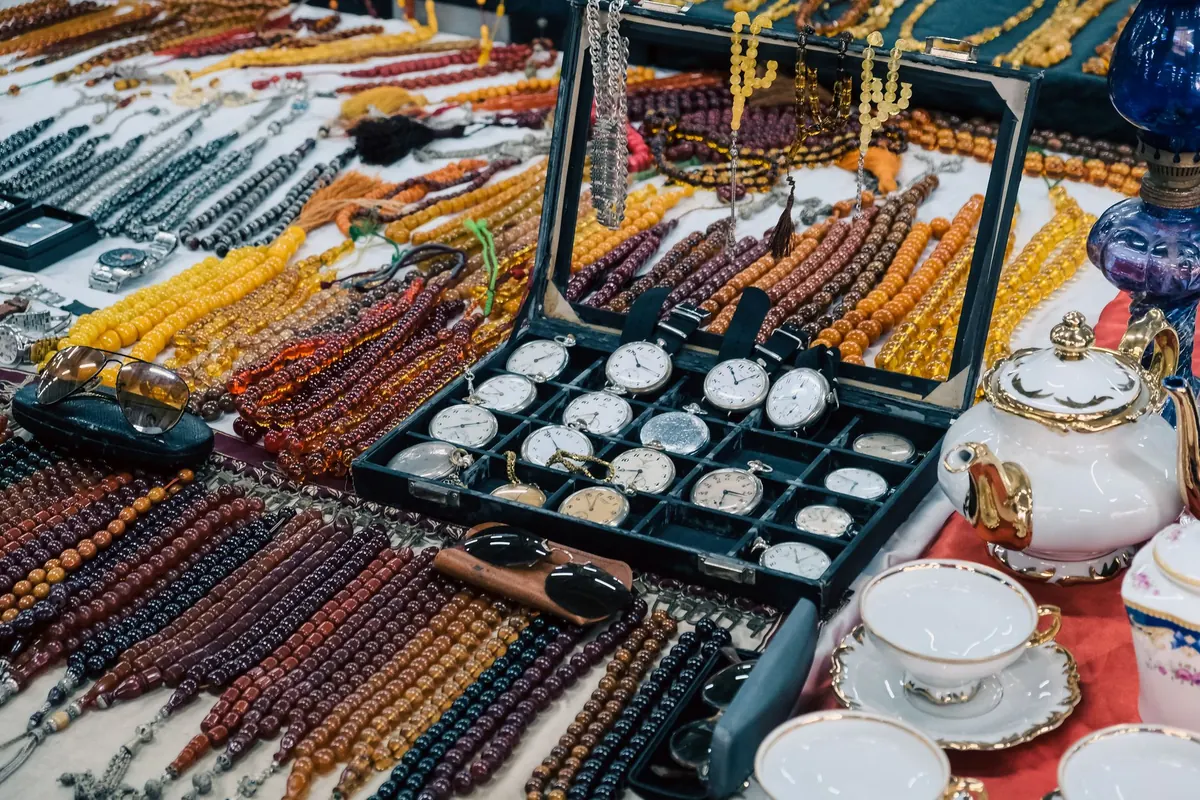
Baltic amber ranges from pale lemon and butter yellow through honey and cognac to deep cherry-red, plus cream, occasional greenish tones and the rare blues and blue-greens. Colour is judged on evenness and depth. A strand of closely matched honey beads takes longer to assemble and usually costs more than an unmatched strand of the same total weight.
Heat treatment is common and, in the Baltic trade, widely accepted when it is disclosed. Gentle heating clarifies cloudy amber and shifts pale material towards cognac and cherry. Stronger heating can create "sun spangles" — flat, glittering disc-like inclusions inside the stone — and can turn some material greenish. Naturally deep cherry and true blue amber are far scarcer, and prices reflect that.
If colour is your deciding factor, ask the seller to describe the piece in daylight rather than under a shop lamp. Warm lighting flatters almost everything, and it is surprisingly easy to buy a honey strand that looks pale and washed out at home.
Beads are measured across in millimetres, and necklaces are usually sold by weight in grams. As a rough guide, a light everyday strand might sit in the 10–20 gram range, a substantial necklace in the 30–50 gram range, and a large collar or statement piece above that. Any single bead over about 20mm has taken a serious amount of rough to produce.
Size affects price disproportionately, because amber is cut from irregular nodules and large clean pieces are scarce. Two beads differing by 3mm can differ by far more than 3mm's worth of value. Shape matters as well: well-matched round beads require more material and more work than chips, nuggets or freeform shapes. Matching is the quiet skill in amber jewellery, and it is often what separates a good strand from a cheap one.
Insects, spiders, feathers and plant fragments preserved inside the resin add interest and, when clearly identifiable and well placed, real value. A crisp, well-lit insect in a clear piece is a different object from a faint smudge near the edge of a cloudy bead.
Treatments and substitutes are where buyers most often overpay, so it pays to know the categories.
Useful checks, none of them conclusive on their own: amber feels warm and light; it usually floats in a saturated salt solution, made by dissolving as much salt as the water will hold; and under long-wave UV light it tends to fluoresce blue-white to yellow-green. Skip the hot needle test, which damages the piece and tells you little you cannot learn another way. The most reliable approach is to buy from a seller who will state in writing what the material is and how it has been treated.
Grading shorthand is helpful, but it is a starting point rather than a verdict. A high grade on a badly photographed, vaguely described listing is worth less than a plain description you can trust. Decide what you actually want before you compare prices: a deep, even cognac with a few internal fractures may please you far more than a flawless pale bead of the same size.
Buy the colour you enjoy, understand the clarity you are paying for, and be honest about how much size you need. Do those three things, ask two or three direct questions of the seller, and the grading labels become what they should be — useful context, not the whole story.
Photo: congerdesign / Pixabay