Trending

A honey-coloured bead lifted from a Bronze Age grave in Wiltshire began its journey on a Baltic beach, more than a thousand miles away. That is the odd fact at the heart of British amber collecting: nearly every ancient piece found in these islands is an import. How it got here is a story of rivers, packhorses, coastal boats and a great many pairs of hands.
Baltic amber, or succinite, is hardened resin from coniferous trees that grew in northern Europe roughly 40 million years ago, during the Eocene. Erosion releases it from deposits along the southern and eastern shores of the Baltic. The Samland peninsula near Kaliningrad is the classic source, with the coasts of Lithuania, Latvia and Poland close behind. Storms tear lumps from the seabed and dump them on the beach, which is why amber has been gathered by hand there for thousands of years, long before anyone could mine it.
Further south, amber simply does not occur in any useful quantity. The whole trade rests on that imbalance.
Amber reaches Britain in small amounts from the Neolithic, but it becomes genuinely visible in the early Bronze Age, in the richly furnished graves of Wessex and beyond. Excavators have recovered necklaces built from amber beads interspersed with thin amber spacer plates, along with amber discs and buttons. The carved amber cup from a barrow at Hove in Sussex is the showpiece of the period.
These objects belong to the same world as the gold, jet and Continental metalwork found in similar graves. Amber was one exotic material among several, and it moved along the same channels.
The route most often described as the Amber Road ran south from the Baltic coast to the Adriatic. Amber travelled up the Vistula and other Polish rivers, through the Moravian Gate — the lowland gap between the Carpathians and the Sudetes — and down towards the Danube. From the Roman frontier at Carnuntum, near modern Vienna, it crossed the Alps by packhorse and mule to Aquileia, the great Adriatic port, and from there ships carried it into the Mediterranean.
This was the road that supplied Greece and Italy. Mycenaean graves contain amber that originated in the Baltic, and Roman customers paid for it in silver. Britain, sitting off the north-west corner of Europe, was not on this route at all.
Amber that reached Britain came the other way, by water. From the amber coast, boats and beach traders moved it west along the German and Dutch shorelines, through Frisia and the Rhine delta, and across the North Sea to East Anglia and Kent. From there it could travel inland by river and track, or hop across the Channel to Gaul and back.
Nobody carried a bead the whole distance. Goods changed hands at every stage — a coastal trader, a river boatman, a smith or bead-maker with contacts inland — and each hand took its cut. That is why the amber in a Wiltshire grave might have passed through a dozen owners before it was finally strung.
Tacitus, writing at the end of the first century AD, described the Aestii on the amber coast gathering the resin from the shallows and trading it onward, apparently without quite understanding what they had. He also repeated the ancient belief that amber was the tears of Phaethon's sisters, or the urine of lynxes. The lynx theory survived for centuries. It is not true.
With the Roman conquest of Britain, amber became part of an organised imperial trade. It appears on Roman sites across the province — London, Colchester and York among them — worked into rings, hairpins, inlay, spindle whorls and gaming counters.
Roman writers valued it highly. Pliny the Elder devoted a book of his Natural History to amber, complained about the price, and noted that a small amber figure could cost more than a healthy slave. He also recorded that a knight sent north by Nero to obtain supplies came back with so much that the netting used to protect spectators in the arena was knotted with amber. The Romans used it in medicine as well as jewellery, though those remedies are of historical interest only.
If you handle old amber, a few simple checks are worth knowing. None of them require chemicals, and none of them should damage the piece.
Store amber away from direct sunlight, radiators and solvents, and keep it from knocking against harder stones in the same tray.
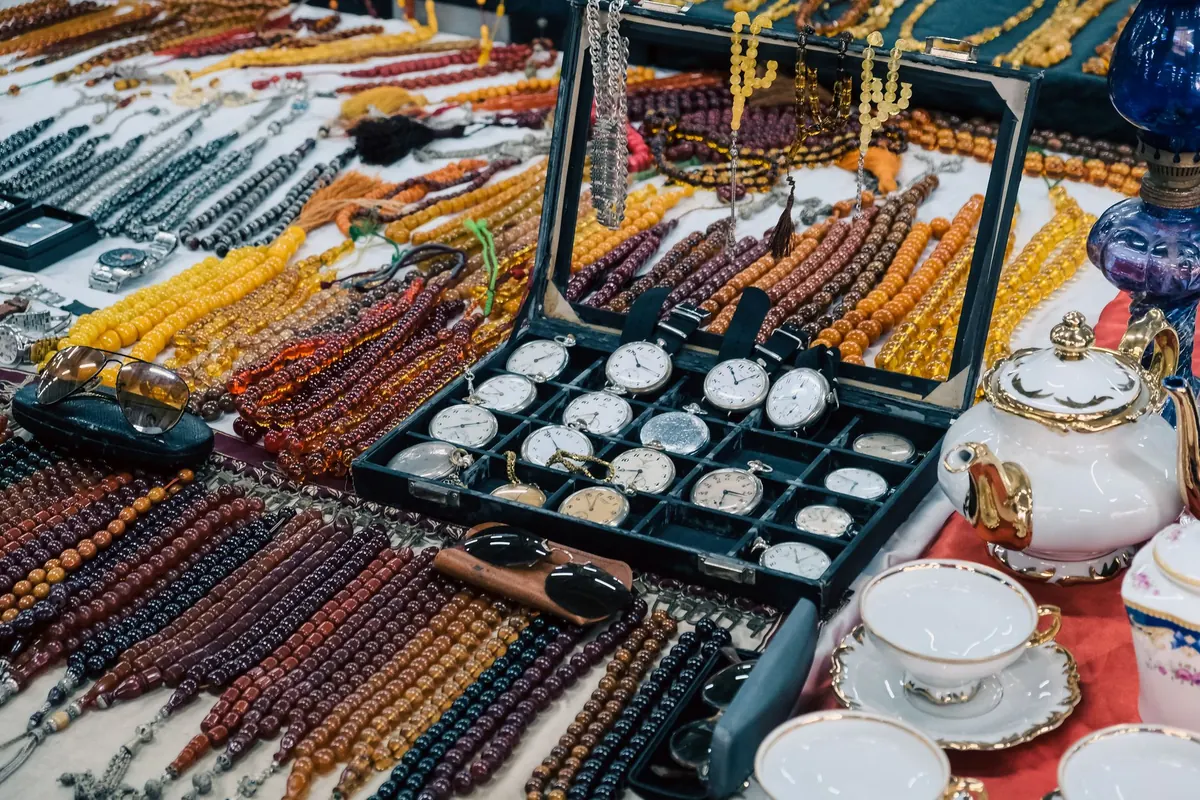
The best place to learn is a museum study collection. The British Museum, Salisbury Museum and many regional museums hold Bronze Age amber, and several run handling sessions where you can look at spacer plates and barrel beads close up. Once you know the shapes, the identification of loose beads gets much easier.
Buy with provenance where you can. A dealer who can say where a piece came from is worth more than one who cannot, particularly with beads said to have been found in Britain. Record what you know about each piece as you acquire it, because that note will outlast your memory of the purchase.
If you want to search for amber yourself, remember that it does occasionally wash up on British beaches, usually as small worn pebbles. Check the current rules before you dig or use a metal detector anywhere, and take proper advice: scheduled monuments are protected, and finds may fall under the Treasure Act. Join a local archaeology or geological society and you will learn more in a season of field walks than in a year of reading.
Photo: 11417994 / Pixabay