Trending

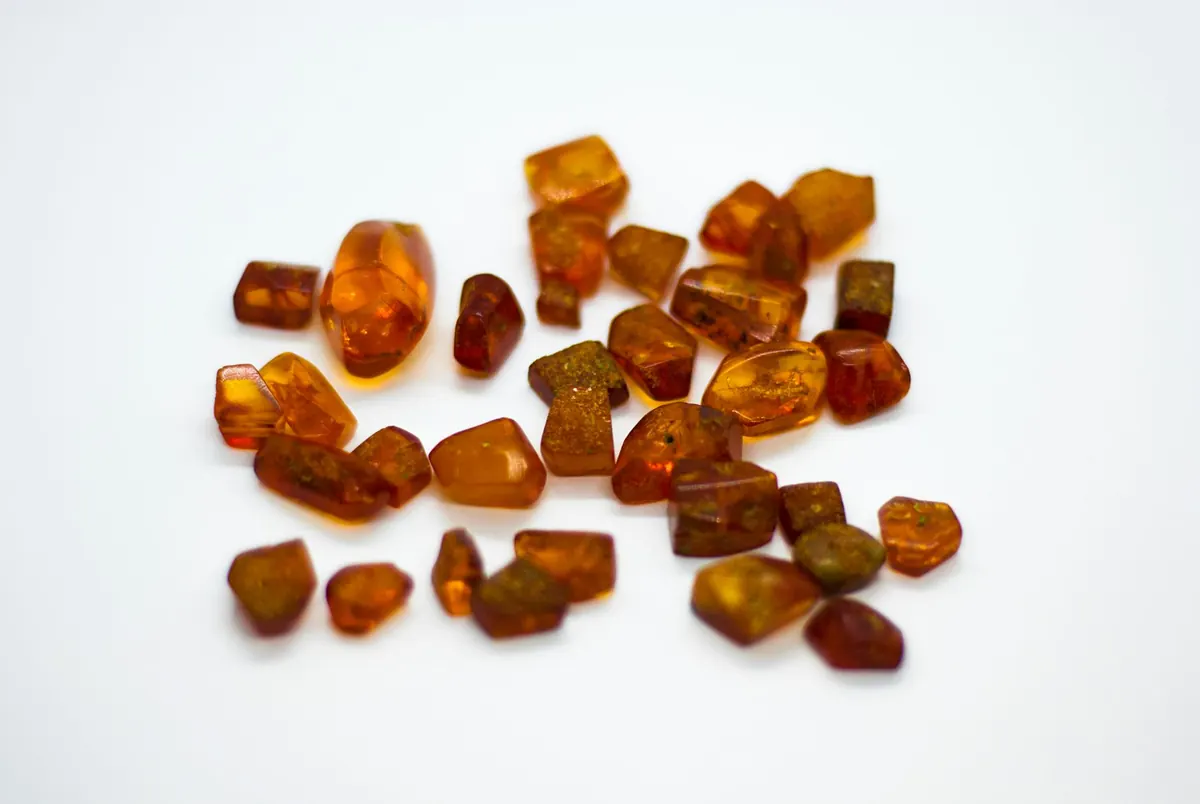
Put a piece of Baltic amber beside a piece of Dominican amber and, on a shop shelf, they can pass for close relatives: the same warmth in the hand, the same surprising lightness. Under a UV torch, through a loupe and on the price tag, the family resemblance falls apart. Here is what separates the two great amber sources — and what those differences mean when you are buying, trading or simply admiring a piece.
Baltic amber formed from the resin of Eocene conifers in northern Europe, roughly 40 to 50 million years ago. Most of it was buried in marine sediments — the glauconite "blue earth" of the Sambia Peninsula — and much of what reaches collectors today was washed out of those deposits and onto Baltic beaches by storms. Kaliningrad, Poland, Lithuania and Latvia are the classic sources; the Ukrainian deposits around Rivne now matter just as much. The material is often called succinite, a nod to its succinic acid content, and that chemistry is one reason Baltic amber behaves differently from Caribbean resin.
Dominican amber is Caribbean and younger, generally placed in the Miocene at around 15 to 20 million years, with some material older. It comes from the mountains of the Dominican Republic — the Cordillera Septentrional, with mines such as La Toca, Palo Quemado and El Valle — and from a tropical legume tree rather than a northern pine. The tree is usually identified as Hymenaea protera, an extinct relative of today's algarrobo. Different tree, different chemistry — and that chemistry underpins almost every difference below.
Honey and cognac are the everyday colours, with lemon yellow at one end and deep cherry-red at the other. Opaque white "bone" amber is valued for carving, and a rare smoky blue-grey material turns up often enough to keep collectors looking. Baltic amber is frequently cloudy, packed with microscopic bubbles that scatter light; the really clear pieces are a small fraction of any batch. Heated Baltic amber develops "sun spangles" — flat, disc-like fractures that glitter as the piece turns. Faceted Baltic amber exists, but beads, cabochons and carved figures are far more common because the rough rarely yields large, clean stones.
Gold and warm reds dominate, alongside a greenish material and, most famously, blue amber. Dominican blue is not blue like a sapphire: it is a golden or brownish resin that throws a startling blue in sunlight or under UV. Clarity is generally better than Baltic on average, with larger transparent windows — which is exactly why Dominican rough is usually cut as polished domes and cabochons designed to show what is inside. A clear Dominican piece with a perfect insect can be left almost uncut, the resin acting as a window rather than a gemstone.
Most Baltic amber shows a soft blue-white to greenish haze under ultraviolet light, with opaque white and some treated pieces glowing strongest. Dominican amber usually gives a milky blue-white, and blue amber lights up with a saturated blue that is hard to mistake. The effect is not merely cosmetic: it is a quick way to sort a mixed tray and to spot pieces that behave oddly.
A 365nm longwave UV torch costs very little and is worth owning. Use it in a genuinely dark room, not a dim one, and compare several pieces side by side rather than judging one in isolation. Two cautions: fluorescence is a comparison tool, not proof of origin, and copal — much younger resin — fluoresces too, often brightly. A glowing piece is not automatically an old one.
Fluorescence is a clue, not a certificate. It tells you what a piece might be; it never tells you what a piece is.
Baltic amber supplies the great bulk of the world's fossil inclusions, most of them tiny: midges, ants, spiders, fragments of web, plant hairs and the occasional feather. A small polished piece with a neat fly inside is affordable and a perfectly good start to a collection. Because Baltic amber was deposited in vast marine beds, it has been mined and beach-combed in enormous quantities, so common inclusions remain accessible.
Dominican amber is where the spectacular inclusions come from — scorpions, large spiders, grasshoppers, frogs and, at the top of the market, lizards. These are genuinely rare. Most Dominican inclusions are still insects, and the glamorous specimens cost what they do precisely because they do not turn up often. A frog or lizard in Dominican amber can sell for thousands or tens of thousands of dollars, while a nice Baltic insect might cost less than dinner.
Whatever you buy, examine the inclusion itself. It should sit inside the resin with no boundary line, air gap or patch of cloudy filler around it. "Planted" inclusions, where a modern insect has been set into a drilled cavity, are a known problem in the trade. Use a loupe or a macro lens and check the following:
Both are soft. Amber sits around 2 to 2.5 on the Mohs scale, softer than a fingernail in some cases, so it scratches easily and should never share a jewellery box with metal or gemstones. It is also vulnerable to solvents, acids, strong perfumes, hairspray and prolonged heat. Ultrasonic cleaners are out; a soft cloth, lukewarm water and a drop of mild soap are in. Store pieces separately, ideally in a padded compartment or a soft pouch.
Baltic and Dominican amber differ slightly in toughness. Baltic amber can be surprisingly resilient because of its cross-linked polymer structure, but it still chips and fractures. Dominican amber, especially the clearer material, can be more brittle and may develop internal fissures over time or during cutting. Neither likes rapid humidity changes, and both can darken or craze if left in direct sun. Treat them as organic artifacts first and gems second.
Price follows the same logic as any collectible: rarity, quality and demand. Baltic amber is abundant. Large beads, cabochons and carved pieces are widely available, and a beginner can build a representative collection for modest money. Exceptional clear pieces, rare colours and high-quality inclusions still command premiums, but the floor is low.
Dominican amber is scarcer, and the gap widens with colour and inclusions. Blue amber is the headline material, and top-grade blue with good size and clarity can cost many times more than ordinary Dominican gold. Add a lizard, a frog or a rare scorpion and the price enters auction territory. The market also punishes naivety: dyed, heated, pressed and reconstituted amber is common, and copal is routinely sold as amber. Buy from dealers who identify origin, disclose treatments and offer a return policy.
The honest answer is that the two are complementary rather than competing. Collect Baltic amber if you want variety of colour and carving, affordable inclusions and a broad introduction to fossil resin. Collect Dominican amber if you are drawn to blue fluorescence, large clear windows and the chance — however small — of a spectacular vertebrate inclusion. Many collectors end up with both: Baltic for the deep history and everyday beauty, Dominican for the drama.
Learn the UV response, carry a loupe, ask about origin and treatment, and buy pieces you enjoy looking at. The differences between Baltic and Dominican amber are real, but the best collection is the one that teaches you something every time you open the drawer.
Photo: Olga Kovalski / Pexels